
Conventional medicine has one job: find disease and treat it.
If you don't have a diagnosable condition, you are — by definition — "healthy."
That's not the same thing as functioning at the level your life demands.
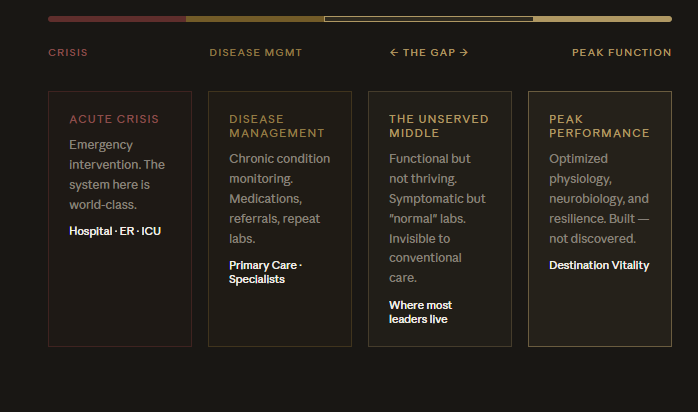
The system is built for the bottom of the spectrum. You're trying to get to the top.
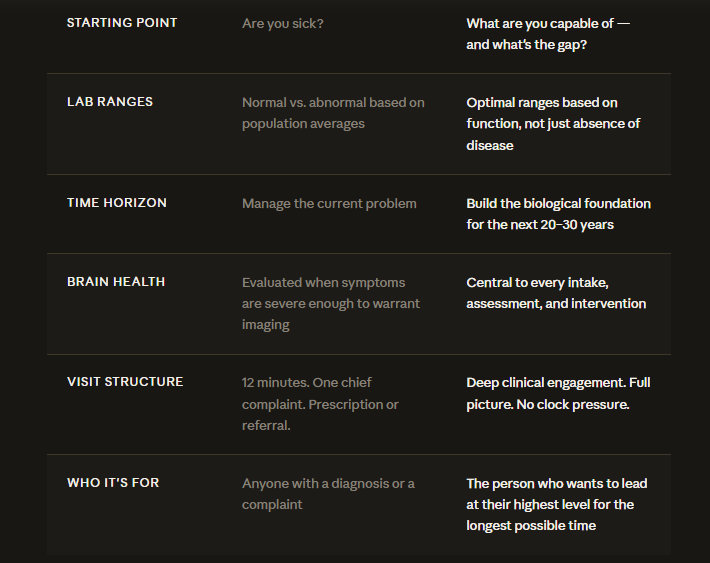
The entire architecture of conventional medicine — the billing codes, the lab reference ranges, the drug protocols — is designed around one question: Is this person sick?
It is extraordinary at answering that question. For everything else, it has almost nothing to offer.
High performers don't live at the bottom of the health spectrum. They live in the middle — functional enough to keep going, compromised enough to know something's wrong, and completely invisible to a system that only activates when pathology is confirmed.
Longevity medicine, functional medicine, and brain health optimization exist in a different conversation entirely — one that asks not "are you sick?" but "what are you capable of, and what's standing between you and that?"
This is not about living longer.
It's about leading longer — at full capacity.
The research on longevity is clear: the variables that determine how long — and how well — you function are measurable, modifiable, and largely ignored by the standard medical visit. The leaders who are still sharp, energized, and decisive at 60 didn't get there by accident. They invested in understanding their biology before it became a problem.
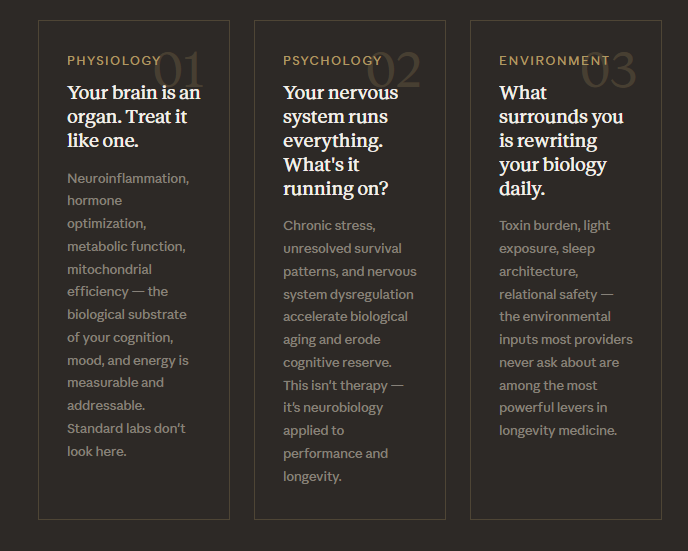
This is not a criticism of conventional medicine. It was never designed for what you're trying to accomplish.
Conventional medicine is exceptional at what it was built to do. You're asking for something it was never built to do. Here's what that difference looks like in practice.
"The most dangerous place for a high-performing leader is in the middle of the health spectrum — functional enough to keep going, compromised enough to know something's wrong, and invisible to every system designed to help them."
Dana Gallik, CRNP, FNP-C · Destination Vitality